Sovereign
A sovereign AI stack: your models, your machine, one endpoint — private by construction, hot-swapped on consumer silicon.
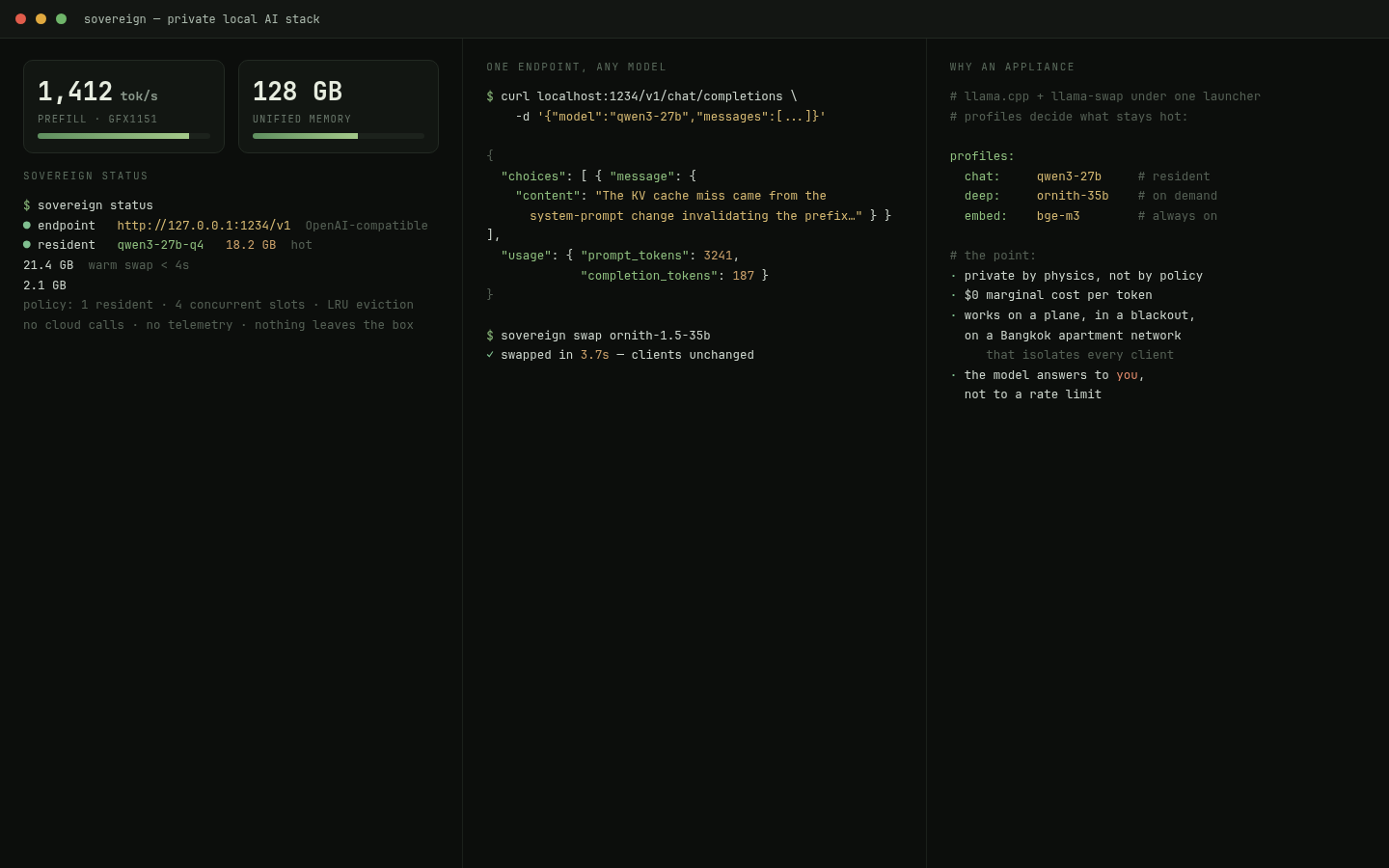
01The problem
Local AI usually arrives as a pile of scripts. A web UI here, a launch script there, a folder of model weights nobody has pruned since March. Every app that wants an OpenAI-compatible endpoint gets its own port and its own mental model; switching models means quitting, waiting, restarting. Nothing fails loudly when a config drifts or a weight file goes missing. It works — the way a workshop works. The goal with Sovereign was the same stack behaving like an appliance: one endpoint, one service, models that swap while everything keeps running.
02The approach
Three layers with a strict division of labor. A custom llama.cpp build
does the inference. llama-swap owns the public API and the engine
lifecycle. A Python launcher resolves configuration and weights, then executes the
selected native engine. Everything downstream — GUIs, agents, editor plugins — talks to
one OpenAI-compatible endpoint at 127.0.0.1:1234/v1 and never learns what
sits behind it.
Profiles are the unit of configuration: a balanced 27B Qwen profile with thinking on, a
fast variant with thinking off, a 12B Gemma for lighter work, an experimental long-context
flash profile. The model field in the API request selects the profile;
llama-swap's exclusive groups handle the swap. One profile is resident at a time — the four
Qwen "slots" mean four concurrent requests to one model, not four loaded models. The CLI
refuses a conflicting load without --replace; the GUI and API can trigger
automatic swapping on demand.
Config is layered TOML: common defaults, then an inherited profile, then a per-platform mapping, merged in a fixed order. The install script verifies published archive SHA-256s for llama-swap and the stock runtime, and records the custom engine's hashes in a runtime manifest. A systemd user service starts the manager at login with no model preloaded — RAM is only spent when a model is actually asked for.
03Trade-offs
--force to skip), and on-demand
requests transparently reload an unloaded model rather than failing.04Under the hood
The paranoia is in the details. A verify command checks weights against
catalog hashes and records destination path, size, mtime, and hash in a verification file.
Storage roots carry volume markers — a sentinel file that catches the wrong drive mounted at
a reused path. Hot reload of config is deliberately disabled: engine startup
rejects drift rather than combining old manager settings with new flags, and
show-config prints resolved paths and a sample argv before you commit to a
change. Unloading is documented as not an atomic admission barrier — the README says so
out loud, because a system you trust has to tell you where its edges are. A unittest suite
and a smoke test against a loaded model gate every change.